About the project
Title:
Reconsidering fungal wood decay mechanisms - uncovering key genetic adaptations to wood decomposition using a broad genomics approach in Basidiomycota
Mehanizmi glivnega razkroja lesa – odkrivanje novih genetskih prilagoditev za razkroj lesa pri bazidiomicetah z uporabo genomskega pristopa
Project number: J4-70171 (C)
Project duration: 1.3.2026 - 28.2.2029
Budget: 450.000 € (for Slovenian partners)
Cofinancing: ARIS 100%
Partnership: 4 partners from 2 countries
Lead partner: Slovenian Forestry Institute




Project overall objective
Introduction and Background of the Research
Wood is one of the largest terrestrial biotic carbon stocks. Its utilization and recycling play a major role in ecosystems, and fungi are the main biotic agents of wood decomposition and nutrient recycling in nature. The basis of wood is plant lignocellulose, a highly resistant and complex polymer matrix that builds and protects plant cells. Fungi are among the few organisms capable of decomposing plant cell walls, but exactly how they do this remains largely unknown.
The most efficient wood decomposers are fungi from the Agaricomycetes group (basidiomycetes), which play a key role in global carbon cycling and the health of terrestrial ecosystems. Despite their immense importance, our basic understanding of wood decomposition mechanisms, their diversity, and evolution is still scanty.
Transcending Traditional Concepts of Wood Decay
Historically, wood-decay fungi have been functionally divided into only three groups: white-rot, brown-rot, and soft-rot fungi. Due to the rapid developments in fungal genetics, we now realize that this traditional classification is too simplified and outdated, as it does not reflect the full diversity of reality. The mentioned three groups are functionally highly heterogeneous internally. The growing compendium of sequenced genomes paves the way for obtaining a much more refined picture and identifying new patterns of wood decay.
Main Objectives and Hypotheses of the Project
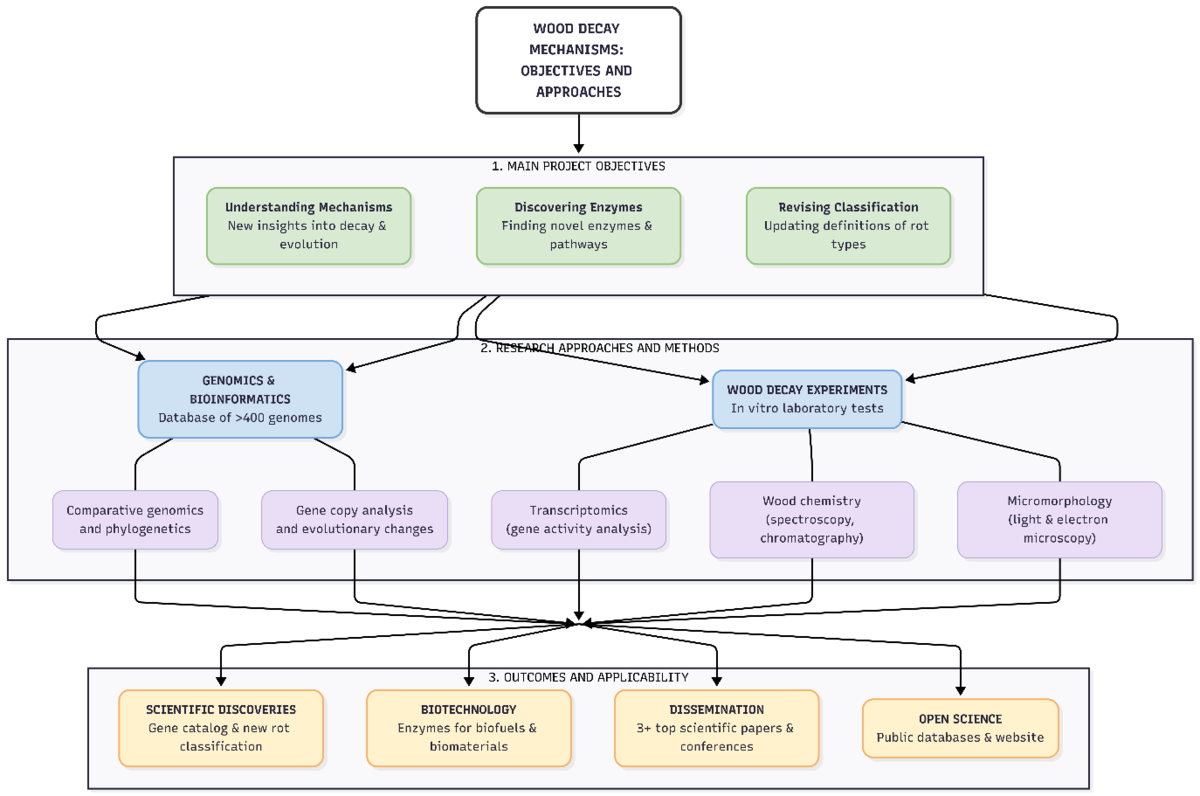
The main goal of the project is to provide a significantly new insight into wood decomposition and the evolution of metabolic pathways for decomposition in Agaricomycetes and other basidiomycetes. The project is based on testing the following three specific research questions/hypotheses:
- Independent evolution of wood decay: The ability to decompose wood evolved independently several times in basidiomycetes. Our preliminary data indicate the presence of wood-degrading ability in certain fungi from the Pucciniomycotina group as well. Such a discovery fundamentally changes our understanding of the early evolution of wood decay ability.
- Discovering new mechanisms: Lesser-known phylogenetic lineages within the Agaricomycetes group most likely possess unique, previously unrecognized enzymatic systems and decay patterns. According to current data, these patterns do not fit the simple division into white or brown rot.
- Revising rot types: Traditionally defined forms of wood decay (white, brown, and soft) are poorly defined and do not reflect real functional diversity at the genomic level. With a more extensive taxonomic sampling, we will critically assess the actual state of degradation systems and the very concept of the wood-decay lifestyle.
Methodology and Multidisciplinary Approach
The project consortium brings together the expertise of four top research groups from diverse but complementary fields: ecology, systematics, comparative genomics, chemistry, and wood science.
Researchers will include in the analysis a unique set of 42 existing, yet unpublished high-quality whole genomes of basidiomycetes. Using state-of-the-art tools, we will perform:
- Comparative genomics approaches, phylogenetics, and analysis of gene copy number dynamics involved in wood decay.
- In-depth laboratory in vitro wood-decay experiments on selected fungal strains.
- Transcriptomics and advanced analyses of wood chemistry and micromorphology, including cutting-edge spectroscopy and light and electron microscopy.
Importance of the Research for the Future
We expect that the results of this innovative project will significantly contribute to new basic knowledge in the fields of mycology, physiology, and genomics of fungi. The project's potential is especially great for industrial biotechnology, which is intensively searching for novel fungal enzymes to develop a fossil-fuel-free bioeconomy. Understanding these enzymes could help improve industrial processes, such as the production of second-generation biofuels, biochemicals, and entirely new biomaterials.